


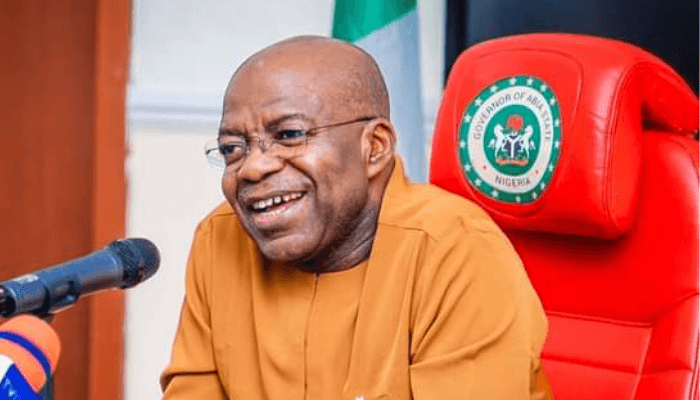
The Governor of Abia State, Dr. Alex Otti, has announced that they are nearing the end of discussions with the Enugu Electricity Distribution Company (EEDC) to take over electricity supply in eight local government areas that currently lack service from Geometric Power.
This move is part of a bigger plan to achieve total electricity independence and boost industrial growth throughout the state.
This information was shared in a statement from Ukoha Njoku Ukoha, the Chief Press Secretary to the Executive Governor of Abia State, on Thursday. Governor Otti recently discussed the ongoing negotiations with the Enugu Electricity Distribution Company (EEDC). The goal of these talks is to establish an independent power supply for the remaining eight local government areas (LGAs). This initiative aims to replicate the successful model already in place in the Aba area, which is powered by Geometric Power. He also noted that the state intends to generate, transmit, distribute, and regulate electricity within its borders, supported by the new Electricity Act that was passed in April.
“Electricity is really important here since all our projects, especially those related to industrialization, rely on a consistent power supply,” Otti said.
“In the upcoming months, we expect to finalize a deal with EEDC that will allow us to separate the remaining eight local governments from EEDC, creating an independent island, just like Aba.”
The governor further explained that the plan to take control of electricity supply in these areas is designed to lessen dependence on national providers and improve service delivery overall. Once this agreement is finalized, it will allow Abia to independently manage power supply across all 17 LGAs.
More insights
Governor Otti announced the appointments of experts to six significant government boards, including the Abia State Advisory Council on Electricity, which is chaired by Dr. Sam Amadi, a former Chairman of the Nigerian Electricity Regulatory Commission (NERC).
The remaining boards include the Umuahia Capital Development Authority, Greater Aba Development Authority, Abia State SME Microfinance Bank Ltd, Abia State Homeland Security, and the Abia State Medicines and Commodities Management Agency.
Otti emphasized that these appointments were based on merit rather than ethnicity, incorporating non-Abians who make valuable contributions to the administration. He highlighted the crucial role of the Electricity Advisory Council in overseeing Abia’s power transition.
Engr. Ikechukwu Monday, the Commissioner for Power and Public Utilities and Co-Chair of the Electricity Advisory Council, expressed gratitude for the opportunity and committed to leveraging the council’s expertise to help the government meet its electricity goals.
The statement pointed out that the state government sees reliable electricity as a fundamental part of economic growth and industrial development. The power reform plan is an important piece of its overall reform strategy.
What you should be enlightened about:
The 188MW Geometric Power Plant located in Aba represents a significant achievement for Abia’s electricity sector, ensuring a reliable power supply to the Aba ringfenced area.
Initially planned in 2004, the project encountered multiple delays before it became operational after being transferred from EEDC to Geometric Power in 2022.
The first phase features four General Electric turbines, with one already running, while the second is in the validation stage, managed by Turkish company KSE Energy and former NEPA executive Engr. Ben Caven.
Geometric has also constructed four new substations, upgraded three existing ones, and installed extensive cabling supported by strong tubular poles.
Once fully operational, the plant is capable of generating 135 million kWh each month, which is sufficient to power about 270,000 households, providing much-needed relief to a state that currently receives only 11.8 percent of the national grid allocations shared with neighboring states.
There are still major challenges to overcome, such as securing a gas supply, enforcing contracts, addressing legacy debts, and implementing cost-reflective tariffs. Nevertheless, the journey towards achieving stable, round-the-clock electricity in Aba is looking more promising.