
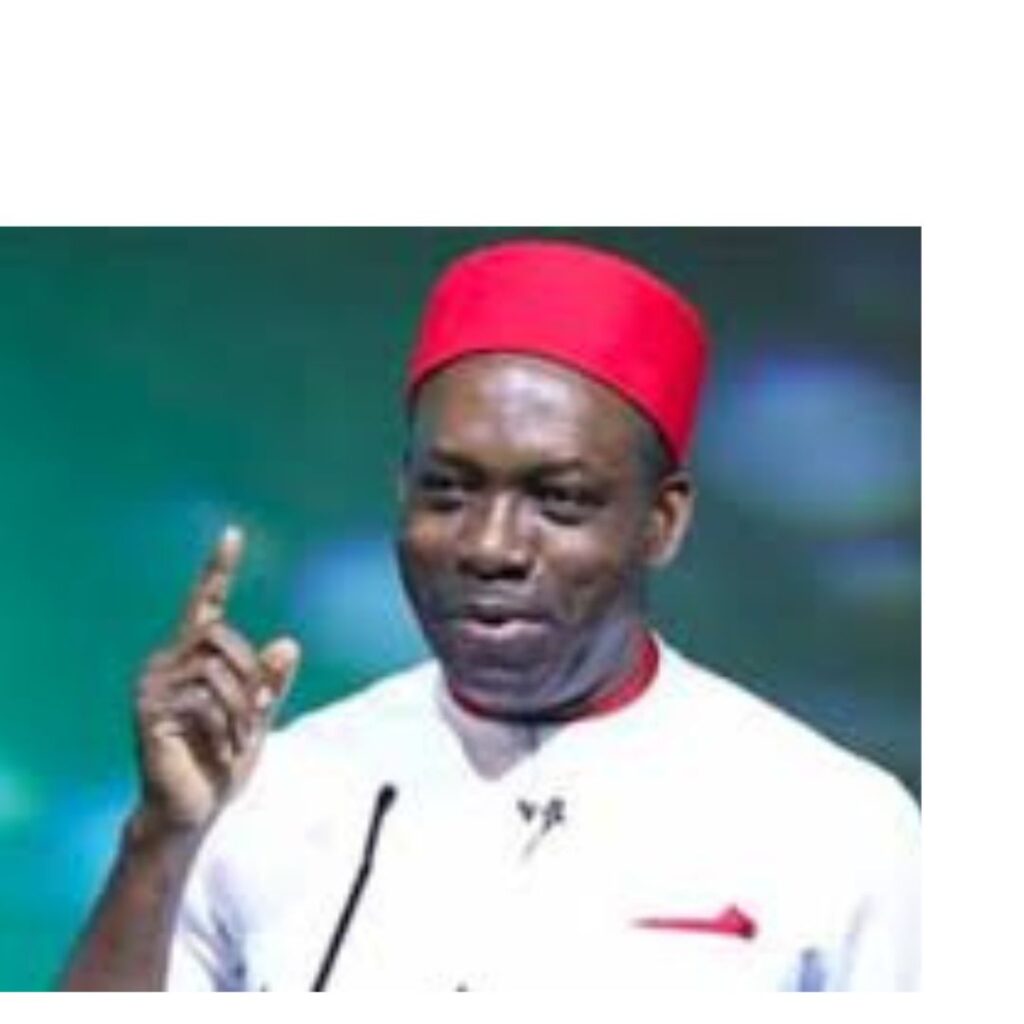
Can We Pause And Ponder Anambra People And Gov. Soludo?
The People Factor in Soludo’s Revolution
By Chuka Nnabuife | ANCISRO
When Governor Chukwuma Charles Soludo appeared on Channels TV’s Sunrise Daily in March 2025, a presenter threw him a loaded question: did his government still consider the welfare of the poor in its economic reforms?
The former Central Bank governor smiled knowingly before replying that “people’s welfare has remained a constant factor in every policy of this administration.” It was a calm answer, but it carried weight — because in Anambra State, Soludo’s politics has increasingly come to mean a fusion of technocratic precision and grassroots empathy.
He went on to lay out, with professorial clarity, the economic planks designed to “put more money in the pockets of the very poor of the poor.” Free education in all state-owned primary and secondary schools; free antenatal and delivery care in public hospitals; abolition of taxes on hawkers, artisans, wheelbarrow pushers and vulcanisers; prompt payment of pensions; subsidised transport for civil servants; and the unfailing monthly payment of wages — all aimed at cushioning ordinary people from the harsh winds of the economy.
When a presenter teased, “Mr Governor, do we now call you a welfarist?” Soludo laughed. “It’s not about labels,” he said. “It’s about making governance have a human face — to touch people meaningfully.”
He then offered a sharp rebuke to the country’s political showmen — those who turn welfare into a spectacle of televised rice-sharing. “That’s not welfare,” he said. “People will eat the food today and go hungry tomorrow. We’re more interested in helping people earn enough to feed their families every day — and to buy whatever grains they choose.”
Planting Prosperity
One of the less publicised aspects of Soludo’s administration is his quiet agricultural revolution. Through the state’s Ministry of Agriculture, Anambra has distributed more than two million improved seedlings and cash crops — oil palms, coconuts, ogbono, ugiri, and other valuable plants — to households across rural and urban areas.
It is, in his own words, “an investment that grows money on trees.” Each plant is a miniature wealth generator, capable of sustaining an entire household in the near future. The governor projects that in four years or less, most homes that planted these crops will begin harvesting substantial income.
This policy may lack the glitz of ribbon-cutting ceremonies, but it represents a quiet, deliberate redistribution of wealth. It transforms backyards into profit-bearing farms and families into producers. It is grassroots prosperity by design — the type that expands household income without the noise of political populism.
A Human-Centred Blueprint
Since the Solution Government came into being in March 2022, the human factor has been its central organising principle. Beyond the free maternity and education schemes, more than 102,000 women have successfully delivered babies in government hospitals without paying a kobo. In the same period, over 13,000 young men and women have been employed in education and health services.
Meanwhile, over 13,000 youths have been trained and financially empowered through the the two phases of the One Youth, Two Skills Solution (1Y2SS) scheme — an initiative that pairs vocational training with business grants, encouraging self-employment and local enterprise. It is one of the most ambitious youth development models in the South-East today.
When President Bola Ahmed Tinubu visited Awka in May 2025, Soludo captured his governing philosophy in one memorable sentence: “Our approach is a reinvention of Awoism — investment in human capital — combined with M. I. Okpara’s palm and coconut revolution. So far, we are on course in implementing our manifesto.”
That statement carries the weight of history. In invoking Obafemi Awolowo and Michael Okpara, Soludo placed his administration in the lineage of visionary Nigerian leaders who viewed economic growth not merely through GDP numbers but through human capacity. Like them, he insists that a prosperous society must be built on productive citizens.
Beyond Handouts: The Economics of Empowerment
Soludo’s understanding of welfarism differs sharply from the hand-to-mouth charity that dominates much of Nigeria’s political theatre. In his academic paper, Towards Sustainable Democracy and Free Market Economy in Nigeria, he argued that handouts and cash gifts, while emotionally satisfying, rarely achieve meaningful impact.
“Money,” he wrote, “is only what money can buy.”
In a time of inflation and currency decline, cash loses meaning within days. For that reason, his government’s social policy prioritises sustainable empowerment over fleeting relief. The objective is not to make people grateful, but capable.
He once illustrated the point with a disarming calculation:
“If we shared all of Anambra’s revenue — both FAAC and IGR — among our 8.5 million residents, no one would receive up to ₦2,500 per month. From that same pot, government must pay salaries, gratuities and pensions, build roads and bridges, invest in health and education, strengthen security and fight erosion.”
In other words, spreading money thinly across millions achieves nothing. But investing strategically in education, skills, and productive enterprise can generate exponential returns. That is the economics behind the Solution brand of governance.
Charly Nwa Mgbafor: The Man Behind the Mission
Soludo’s politics is deeply personal. He proudly calls himself “Charly Nwa Mgbafor” — the son of the struggling street-side trader, his late mother, Mgbafor, a roadside akara (bean cake) seller. It’s a nickname he wears like a badge of honour, reminding both himself and others of the humbling origins that shaped his social conscience. And he has a vision of a better clime and kinder social cushion for the women and men like his beloved late mom.
“For that roadside pepper seller, hawker or okada rider,” he once said, “even if we can’t immediately change their own condition, we must ensure that their children don’t end up like them. We must have that social agenda.”
That simple sentence captures the philosophy behind his administration: governance that breaks the cycle of poverty not through pity but through opportunity. It’s an inheritance of empathy translated into policy.
A Revolution Rooted in People
Across Anambra, the signs of transformation are visible — new schools, repaired roads, rejuvenated hospitals, revitalised markets. Yet beyond the physical projects lies a subtler revolution: a new social contract between government and citizens, built on trust, transparency, and tangible results.
Soludo’s government has not solved every problem, but it has redefined what governance can look like when driven by intellect and integrity. In a political culture obsessed with slogans and instant applause, he has chosen the harder path — building systems that may take years to mature but will endure for generations.
That patience, too, is part of the people factor. For real progress is rarely dramatic; it grows quietly, like seedlings taking root.
As Nigeria grapples with economic uncertainty and political cynicism, Anambra’s experiment offers a lesson worth studying. Social reform need not mean state dependency, and economic efficiency need not exclude compassion. When done right, the two reinforce each other — as Soludo’s policies are beginning to show.
The Meaning of the Solution
Ultimately, what distinguishes Soludo’s revolution is not merely its ambition but its coherence. Each policy — from free schooling to agricultural empowerment — flows from one moral centre: that people are the state’s greatest capital. The poorest citizen is not a burden to be managed but a potential contributor to be enabled.
It is a vision that stands in contrast to the politics of tokenism that has long dominated public life. Soludo’s idea of governance is less about dispensing largesse and more about cultivating independence. It’s about replacing handouts with hands-on tools.
And that, perhaps, is the true meaning of his campaign slogan, The Solution.
For if Nigeria’s many problems share one root — the disconnection between power and people — then the only lasting remedy is leadership that remembers where it came from and who it serves.
Governor Soludo may be an economist by training, but his revolution is as human as it gets. His policies may read like spreadsheets, but their heartbeat is unmistakably social.
In every school child who now studies free of charge, in every mother who delivers safely without paying a dime, in every youth who learns a trade and starts a business, there is a conscience-pricking sober but penetrating drumbeat serenading them with ‘the people factor’ in Soludo’s revolution. The inner mind rhythm beats quietly but persuasively as the governor continues in his style of steadily, transforming lives — one initiative at a time.
- Nnabuife, Managing Director of Anambra State Civic and Social Reformation Office (ANCISRO) wrote from Awka
Can We Pause And Ponder Anambra People And Gov. Soludo?
The People Factor in Soludo’s Revolution
By Chuka Nnabuife | ANCISRO
When Governor Chukwuma Charles Soludo appeared on Channels TV’s Sunrise Daily in March 2025, a presenter threw him a loaded question: did his government still consider the welfare of the poor in its economic reforms?
The former Central Bank governor smiled knowingly before replying that “people’s welfare has remained a constant factor in every policy of this administration.” It was a calm answer, but it carried weight — because in Anambra State, Soludo’s politics has increasingly come to mean a fusion of technocratic precision and grassroots empathy.
He went on to lay out, with professorial clarity, the economic planks designed to “put more money in the pockets of the very poor of the poor.” Free education in all state-owned primary and secondary schools; free antenatal and delivery care in public hospitals; abolition of taxes on hawkers, artisans, wheelbarrow pushers and vulcanisers; prompt payment of pensions; subsidised transport for civil servants; and the unfailing monthly payment of wages — all aimed at cushioning ordinary people from the harsh winds of the economy.
When a presenter teased, “Mr Governor, do we now call you a welfarist?” Soludo laughed. “It’s not about labels,” he said. “It’s about making governance have a human face — to touch people meaningfully.”
He then offered a sharp rebuke to the country’s political showmen — those who turn welfare into a spectacle of televised rice-sharing. “That’s not welfare,” he said. “People will eat the food today and go hungry tomorrow. We’re more interested in helping people earn enough to feed their families every day — and to buy whatever grains they choose.”
Planting Prosperity
One of the less publicised aspects of Soludo’s administration is his quiet agricultural revolution. Through the state’s Ministry of Agriculture, Anambra has distributed more than two million improved seedlings and cash crops — oil palms, coconuts, ogbono, ugiri, and other valuable plants — to households across rural and urban areas.
It is, in his own words, “an investment that grows money on trees.” Each plant is a miniature wealth generator, capable of sustaining an entire household in the near future. The governor projects that in four years or less, most homes that planted these crops will begin harvesting substantial income.
This policy may lack the glitz of ribbon-cutting ceremonies, but it represents a quiet, deliberate redistribution of wealth. It transforms backyards into profit-bearing farms and families into producers. It is grassroots prosperity by design — the type that expands household income without the noise of political populism.
A Human-Centred Blueprint
Since the Solution Government came into being in March 2022, the human factor has been its central organising principle. Beyond the free maternity and education schemes, more than 102,000 women have successfully delivered babies in government hospitals without paying a kobo. In the same period, over 13,000 young men and women have been employed in education and health services.
Meanwhile, over 13,000 youths have been trained and financially empowered through the the two phases of the One Youth, Two Skills Solution (1Y2SS) scheme — an initiative that pairs vocational training with business grants, encouraging self-employment and local enterprise. It is one of the most ambitious youth development models in the South-East today.
When President Bola Ahmed Tinubu visited Awka in May 2025, Soludo captured his governing philosophy in one memorable sentence: “Our approach is a reinvention of Awoism — investment in human capital — combined with M. I. Okpara’s palm and coconut revolution. So far, we are on course in implementing our manifesto.”
That statement carries the weight of history. In invoking Obafemi Awolowo and Michael Okpara, Soludo placed his administration in the lineage of visionary Nigerian leaders who viewed economic growth not merely through GDP numbers but through human capacity. Like them, he insists that a prosperous society must be built on productive citizens.
Beyond Handouts: The Economics of Empowerment
Soludo’s understanding of welfarism differs sharply from the hand-to-mouth charity that dominates much of Nigeria’s political theatre. In his academic paper, Towards Sustainable Democracy and Free Market Economy in Nigeria, he argued that handouts and cash gifts, while emotionally satisfying, rarely achieve meaningful impact.
“Money,” he wrote, “is only what money can buy.”
In a time of inflation and currency decline, cash loses meaning within days. For that reason, his government’s social policy prioritises sustainable empowerment over fleeting relief. The objective is not to make people grateful, but capable.
He once illustrated the point with a disarming calculation:
“If we shared all of Anambra’s revenue — both FAAC and IGR — among our 8.5 million residents, no one would receive up to ₦2,500 per month. From that same pot, government must pay salaries, gratuities and pensions, build roads and bridges, invest in health and education, strengthen security and fight erosion.”
In other words, spreading money thinly across millions achieves nothing. But investing strategically in education, skills, and productive enterprise can generate exponential returns. That is the economics behind the Solution brand of governance.
Charly Nwa Mgbafor: The Man Behind the Mission
Soludo’s politics is deeply personal. He proudly calls himself “Charly Nwa Mgbafor” — the son of the struggling street-side trader, his late mother, Mgbafor, a roadside akara (bean cake) seller. It’s a nickname he wears like a badge of honour, reminding both himself and others of the humbling origins that shaped his social conscience. And he has a vision of a better clime and kinder social cushion for the women and men like his beloved late mom.
“For that roadside pepper seller, hawker or okada rider,” he once said, “even if we can’t immediately change their own condition, we must ensure that their children don’t end up like them. We must have that social agenda.”
That simple sentence captures the philosophy behind his administration: governance that breaks the cycle of poverty not through pity but through opportunity. It’s an inheritance of empathy translated into policy.
A Revolution Rooted in People
Across Anambra, the signs of transformation are visible — new schools, repaired roads, rejuvenated hospitals, revitalised markets. Yet beyond the physical projects lies a subtler revolution: a new social contract between government and citizens, built on trust, transparency, and tangible results.
Soludo’s government has not solved every problem, but it has redefined what governance can look like when driven by intellect and integrity. In a political culture obsessed with slogans and instant applause, he has chosen the harder path — building systems that may take years to mature but will endure for generations.
That patience, too, is part of the people factor. For real progress is rarely dramatic; it grows quietly, like seedlings taking root.
As Nigeria grapples with economic uncertainty and political cynicism, Anambra’s experiment offers a lesson worth studying. Social reform need not mean state dependency, and economic efficiency need not exclude compassion. When done right, the two reinforce each other — as Soludo’s policies are beginning to show.
The Meaning of the Solution
Ultimately, what distinguishes Soludo’s revolution is not merely its ambition but its coherence. Each policy — from free schooling to agricultural empowerment — flows from one moral centre: that people are the state’s greatest capital. The poorest citizen is not a burden to be managed but a potential contributor to be enabled.
It is a vision that stands in contrast to the politics of tokenism that has long dominated public life. Soludo’s idea of governance is less about dispensing largesse and more about cultivating independence. It’s about replacing handouts with hands-on tools.
And that, perhaps, is the true meaning of his campaign slogan, The Solution.
For if Nigeria’s many problems share one root — the disconnection between power and people — then the only lasting remedy is leadership that remembers where it came from and who it serves.
Governor Soludo may be an economist by training, but his revolution is as human as it gets. His policies may read like spreadsheets, but their heartbeat is unmistakably social.
In every school child who now studies free of charge, in every mother who delivers safely without paying a dime, in every youth who learns a trade and starts a business, there is a conscience-pricking sober but penetrating drumbeat serenading them with ‘the people factor’ in Soludo’s revolution. The inner mind rhythm beats quietly but persuasively as the governor continues in his style of steadily, transforming lives — one initiative at a time.
- Nnabuife, Managing Director of Anambra State Civic and Social Reformation Office (ANCISRO) wrote from Awka
The People Factor in Soludo’s Revolution
By Chuka Nnabuife | ANCISRO
When Governor Chukwuma Charles Soludo appeared on Channels TV’s Sunrise Daily in March 2025, a presenter threw him a loaded question: did his government still consider the welfare of the poor in its economic reforms?
The former Central Bank governor smiled knowingly before replying that “people’s welfare has remained a constant factor in every policy of this administration.” It was a calm answer, but it carried weight — because in Anambra State, Soludo’s politics has increasingly come to mean a fusion of technocratic precision and grassroots empathy.
He went on to lay out, with professorial clarity, the economic planks designed to “put more money in the pockets of the very poor of the poor.” Free education in all state-owned primary and secondary schools; free antenatal and delivery care in public hospitals; abolition of taxes on hawkers, artisans, wheelbarrow pushers and vulcanisers; prompt payment of pensions; subsidised transport for civil servants; and the unfailing monthly payment of wages — all aimed at cushioning ordinary people from the harsh winds of the economy.
When a presenter teased, “Mr Governor, do we now call you a welfarist?” Soludo laughed. “It’s not about labels,” he said. “It’s about making governance have a human face — to touch people meaningfully.”
He then offered a sharp rebuke to the country’s political showmen — those who turn welfare into a spectacle of televised rice-sharing. “That’s not welfare,” he said. “People will eat the food today and go hungry tomorrow. We’re more interested in helping people earn enough to feed their families every day — and to buy whatever grains they choose.”
Planting Prosperity
One of the less publicised aspects of Soludo’s administration is his quiet agricultural revolution. Through the state’s Ministry of Agriculture, Anambra has distributed more than two million improved seedlings and cash crops — oil palms, coconuts, ogbono, ugiri, and other valuable plants — to households across rural and urban areas.
It is, in his own words, “an investment that grows money on trees.” Each plant is a miniature wealth generator, capable of sustaining an entire household in the near future. The governor projects that in four years or less, most homes that planted these crops will begin harvesting substantial income.
This policy may lack the glitz of ribbon-cutting ceremonies, but it represents a quiet, deliberate redistribution of wealth. It transforms backyards into profit-bearing farms and families into producers. It is grassroots prosperity by design — the type that expands household income without the noise of political populism.
A Human-Centred Blueprint
Since the Solution Government came into being in March 2022, the human factor has been its central organising principle. Beyond the free maternity and education schemes, more than 102,000 women have successfully delivered babies in government hospitals without paying a kobo. In the same period, over 13,000 young men and women have been employed in education and health services.
Meanwhile, over 13,000 youths have been trained and financially empowered through the the two phases of the One Youth, Two Skills Solution (1Y2SS) scheme — an initiative that pairs vocational training with business grants, encouraging self-employment and local enterprise. It is one of the most ambitious youth development models in the South-East today.
When President Bola Ahmed Tinubu visited Awka in May 2025, Soludo captured his governing philosophy in one memorable sentence: “Our approach is a reinvention of Awoism — investment in human capital — combined with M. I. Okpara’s palm and coconut revolution. So far, we are on course in implementing our manifesto.”
That statement carries the weight of history. In invoking Obafemi Awolowo and Michael Okpara, Soludo placed his administration in the lineage of visionary Nigerian leaders who viewed economic growth not merely through GDP numbers but through human capacity. Like them, he insists that a prosperous society must be built on productive citizens.
Beyond Handouts: The Economics of Empowerment
Soludo’s understanding of welfarism differs sharply from the hand-to-mouth charity that dominates much of Nigeria’s political theatre. In his academic paper, Towards Sustainable Democracy and Free Market Economy in Nigeria, he argued that handouts and cash gifts, while emotionally satisfying, rarely achieve meaningful impact.
“Money,” he wrote, “is only what money can buy.”
In a time of inflation and currency decline, cash loses meaning within days. For that reason, his government’s social policy prioritises sustainable empowerment over fleeting relief. The objective is not to make people grateful, but capable.
He once illustrated the point with a disarming calculation:
“If we shared all of Anambra’s revenue — both FAAC and IGR — among our 8.5 million residents, no one would receive up to ₦2,500 per month. From that same pot, government must pay salaries, gratuities and pensions, build roads and bridges, invest in health and education, strengthen security and fight erosion.”
In other words, spreading money thinly across millions achieves nothing. But investing strategically in education, skills, and productive enterprise can generate exponential returns. That is the economics behind the Solution brand of governance.
Charly Nwa Mgbafor: The Man Behind the Mission
Soludo’s politics is deeply personal. He proudly calls himself “Charly Nwa Mgbafor” — the son of the struggling street-side trader, his late mother, Mgbafor, a roadside akara (bean cake) seller. It’s a nickname he wears like a badge of honour, reminding both himself and others of the humbling origins that shaped his social conscience. And he has a vision of a better clime and kinder social cushion for the women and men like his beloved late mom.
“For that roadside pepper seller, hawker or okada rider,” he once said, “even if we can’t immediately change their own condition, we must ensure that their children don’t end up like them. We must have that social agenda.”
That simple sentence captures the philosophy behind his administration: governance that breaks the cycle of poverty not through pity but through opportunity. It’s an inheritance of empathy translated into policy.
A Revolution Rooted in People
Across Anambra, the signs of transformation are visible — new schools, repaired roads, rejuvenated hospitals, revitalised markets. Yet beyond the physical projects lies a subtler revolution: a new social contract between government and citizens, built on trust, transparency, and tangible results.
Soludo’s government has not solved every problem, but it has redefined what governance can look like when driven by intellect and integrity. In a political culture obsessed with slogans and instant applause, he has chosen the harder path — building systems that may take years to mature but will endure for generations.
That patience, too, is part of the people factor. For real progress is rarely dramatic; it grows quietly, like seedlings taking root.
As Nigeria grapples with economic uncertainty and political cynicism, Anambra’s experiment offers a lesson worth studying. Social reform need not mean state dependency, and economic efficiency need not exclude compassion. When done right, the two reinforce each other — as Soludo’s policies are beginning to show.
The Meaning of the Solution
Ultimately, what distinguishes Soludo’s revolution is not merely its ambition but its coherence. Each policy — from free schooling to agricultural empowerment — flows from one moral centre: that people are the state’s greatest capital. The poorest citizen is not a burden to be managed but a potential contributor to be enabled.
It is a vision that stands in contrast to the politics of tokenism that has long dominated public life. Soludo’s idea of governance is less about dispensing largesse and more about cultivating independence. It’s about replacing handouts with hands-on tools.
And that, perhaps, is the true meaning of his campaign slogan, The Solution.
For if Nigeria’s many problems share one root — the disconnection between power and people — then the only lasting remedy is leadership that remembers where it came from and who it serves.
Governor Soludo may be an economist by training, but his revolution is as human as it gets. His policies may read like spreadsheets, but their heartbeat is unmistakably social.
In every school child who now studies free of charge, in every mother who delivers safely without paying a dime, in every youth who learns a trade and starts a business, there is a conscience-pricking sober but penetrating drumbeat serenading them with ‘the people factor’ in Soludo’s revolution. The inner mind rhythm beats quietly but persuasively as the governor continues in his style of steadily, transforming lives — one initiative at a time.
- Nnabuife, Managing Director of Anambra State Civic and Social Reformation Office (ANCISRO) wrote from Awka