


.As Abeokuta Residents Lament High Cost Of Ram, Settle For Alternatives
All Farmers Association of Nigeria (AFAN) and foodstuff traders in Lagos have lamented low patronage of foodstuff this Sallah season due to inflation which affected consumers purchasing power.
The association and the traders disclosed this in separate interviews with the News Agency of Nigeria (NAN) on Thursday in Lagos.
The Lagos State AFAN Vice Chairman, Mr Shakin Agbayewa, said consumers purchasing power had reduced in spite of the drop in the price of some produce in the country.
“The celebration this year is associated with mixed feelings. Some of the produce have dropped in price but the purchasing power of the people have dropped.
“The price of a bag of rice in Lagos State and its environs is between N51,000 and N57,000 depending on the location. However, people can buy rice, the ram but have no money to buy pepper to cook for the Sallah.
“For pepper, as of today, pepper is on the high side. It is really on the high side. A lot of people are complaining about pepper.
“We encourage people to start cultivating pepper in the state. The cost of transportation is what has made pepper costly at this celebration season.
“Sometimes, I think, the price hike of these produce during the Sallah celebration is intentional, the traders just want to make extra profit because of the celebration.
“After the celebration, the prices of pepper and tomatoes I believe will drop,” Agbayewa said
On her part, Mrs Tolu Agunbiade, a foodstuff trader at Agege area of the state, said patronage was quite low when compared with 2024 Sallah.
“The price of rice has drastically dropped in comparison to last year’s Sallah celebration. A bag of rice now sells between N56,000 and N62,000 depending on the location and species. In comparison to last year’s celebration, a bag sold at N98,000 to N110,000.
“However, the purchasing power of the consumers is quite low, people are not buying as they ought to, even with the reduced price.
“Even the price of groundnut oil has dropped, last year a five litre keg sold for N13,000 to N16,000, presently, the same quantity sells at N10,000 but the patronage is quite low,” Agunbiade said.
A caterer and foodstuff trader, Mrs Pat Gbagi, said prices would drop after the Sallah celebration, while urging consumers to be patient.
“This week, the price of tomatoes and pepper is quite high due to the Sallah celebration.
“The cost of pepper is astronomically high, a bag of pepper at Mile 12 market sold at N200,000 but today the same quantity sells between N250,000 and N300,000.
“If not the celebration, I do not advise anyone to go to the market this week. However, people will only buy what they can afford,” Gbagi said.
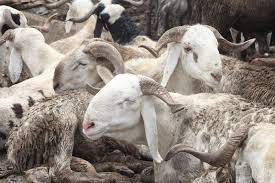
Meanwhile, ahead of the Eid-el-Kabir celebration, residents of Abeokuta and its environs have lamented the high cost of ram, while opting for alternatives.
Some of them who spoke with the News Agency of Nigeria (NAN) on Thursday in separate interviews, noted that the exhorbitant prices of sacrificial animals could make them seek alternatives.
Alh. Ganiyu Babalola, a civil servant, explained that he used to buy, at least, two rams to celebrate the festival with his parents and children.
Babalola said the amount spent in 2024 to buy two rams is what he spent buying one this year.
” I remembered I bought the two rams N250,000 each but this year I got one for N470,000. Instead of buying two, I called my siblings and we contributed to buy a cow to support the ram I bought,” he said.
Akande Jimoh, a welder, said he has no plan to buy a ram this year, considering the cost implications.
” I can not afford to buy a ram this year. The price of a big ram ranges from N550,000 to N800,000. Where will I get such money.
“I have decided to take two of the goats I am rearing to celebrate the festival. My God will understand.
“I wish the government has the power to control the prices of this animals,” he said.
On her part, Mrs Bidemi Ahmed, said “ram, whether big or small is not affordable this year compared to 2024.
“Although, my husband has bought one, but I must say I’m not so happy with the choice he settled for, at the rate of N250,000.
“Gone are those days when they will be begging you to buy, but right now, when you turn your back, they won’t even call you back,” she said.
Mallam Abdulfatah Akanni, an Islamic scholar, described the situation as a challenging moment for Muslims.
“As Muslims, we have to be cautious. Let’s cut our coat according to the size of our clothes,” he said.
A check by NAN to Rounder and Lafenwa ram markets indicated that most people expressed displeasure over the costs of ram.
Malam Yusuf Sanusi, a ram vendor, attributed the high cost of ram to transportation cost and other logistics.
Sanusi explained that transporting the animals from the northern part of the country cost more, compared to last year.
He also attributed the high cost to low supply and insecurity in some parts of the northern states.(NAN)