

President Trump expressed confidence that the U.S. will handle the crisis in Gaza, highlighting the dire situation where many face starvation in the blockaded Palestinian area, a worry that humanitarian groups have been sounding the alarm about for months. ‘We’re closely monitoring what’s happening in Gaza and will strive for a solution. A lot of people are suffering from hunger,’ the president told reporters.
Mr. Trump made this statement as he concluded the last part of his extensive tour of Arab nations in the Middle East, including Qatar, a key U.S. ally, and Egypt, as they work to negotiate a ceasefire in the ongoing Israel-Hamas conflict.
For more than two months, Israel has kept Gaza under blockade, prompting the United Nations agencies and several humanitarian groups to raise alarms about the quickly depleting stocks of fuel, food, and medicine in an area that was home to around 2.4 million people before the war started.
Following U.S. Secretary of State Marco Rubio’s openness to finding new ways to help Gaza, Mr. Trump made remarks amid widespread criticism of a plan backed by the U.S. and Israel, as concerns grew over the dire circumstances unfolding in the region.
Thousands of children in Gaza severely malnourished, this according to a statement made by the United Nations
The United Nations’ World Food Programme has reported that more than 14,000 kids in Gaza are facing severe malnutrition. One of them is six-year-old Najwa Hajaj, who had to leave a local hospital because there wasn’t enough food or medicine. Her mom shared that she only weighs 13 pounds, which is what a three-month-old baby typically weighs.
Sadly, her sister died from hunger last year, and now their parents are terrified of losing another child. ‘I feel like she’s slipping away, and I can’t do anything to help,’ her dad, Hussain Hajaj, said in an interview. ‘I barely have anything to give her; I’m completely lost.’ Right now, all he has is baby formula. Adnan Hanza, a medical student who volunteered at a European hospital in southern Gaza, mentioned that he saw a worrying increase in malnutrition cases before the hospital had to close due to nearby Israeli airstrikes.
‘Malnutrition is everywhere here,’ Hanza remarked. ‘People look like walking skeletons on the streets.’ He and his family are living in a bombed-out home they returned to after being displaced an incredible twelve times. His mom painted a grim picture of their situation by showing her empty kitchen cupboards, saying their little bit of food wouldn’t last them more than a week.
Relentless Israeli strikes kill dozens in Gaza
The civil defense rescue agency in Gaza has announced that since midnight, Israeli airstrikes have sadly resulted in the deaths of 50 individuals in the Palestinian territory. Mohammed al-Mughayyir, a civil defense official, mentioned, ‘The number of victims from Israeli strikes on civilian homes in northern Gaza has unfortunately reached 50. Our teams are working hard in the impacted areas.’
Yousef Al-Sultan, a 40-year-old resident from the al-Salatin area near Beit Lahia said. The Israeli forces hit the house next to mine, striking it directly while people were inside,’ as he recounted the chaos caused by airstrikes, artillery fire, and drone attacks.
‘A massive wave of displacement is affecting the civilian population. We are filled with fear and panic during the night,’ he expressed. Catherine Russell, head of the U.N. Children’s Fund, voiced her concerns on social media, revealing that Israel’s actions in Gaza have led to the deaths of 45 children in just two days, a situation she called ‘unconscionable.’ ‘This should awaken the world, yet it is largely met with indifference,’ Russell noted. ‘There is no safe place for children in Gaza. This violence must end.’ She warned that over 1 million children in Gaza were at risk of starvation, lacking essential food, water, and medical supplies.
Even though there hasn’t been a quick response to the recent airstrikes in northern Gaza by the Israel Defense Forces, reports from Israeli media said that it was part of a stepped-up operation that might involve more ground operations. The IDF has consistently stated that since the conflict began that their military efforts are solely focused on Hamas and other terrorist organizations in Gaza, which they say are concealing weapons and fighters in civilian infrastructure.
Qatar and hostage families call on Netanyahu to make a deal
Israeli sources estimate that 251 people, mostly civilians were taken by Hamas and allies groups during the October 7 raid, resulting in over 1,200 deaths. The captives were brought back to Gaza, and many were freed during two separate ceasefires.
Israeli authorities think that 58 people are still held in Gaza, with around 20 likely still alive. For months, the families of the hostages have been protesting, asking Israeli Prime Minister Benjamin Netanyahu to talk to Hamas to help get their loved ones back. They are really worried about the increasing military actions in Gaza, which they believe put their family members in danger. As President Trump is about to finish a trip to three Middle Eastern countries—without visiting Israel—the families are pushing harder for Netanyahu to back Trump’s efforts for a deal with Hamas.
On Friday, the Hostages and Missing Families Forum released a heartfelt statement about the sadness and worry that the families of the hostages are experiencing. They said, ‘Today, the families woke up feeling heavy-hearted, anxious about the rising violence in Gaza and the end of President Trump’s visit. We are at a crucial point that will decide the fate of our loved ones, the future of Israeli society, and the whole Middle East. Missing this important chance would be a serious mistake that history will remember.
We strongly advise Prime Minister Netanyahu to cooperate with the ideas of President Trump, which are crucial for releasing the 58 hostages and signing crucial deals in the vicinity.Time is running out, the world is watching, and history will remember what we do.’ At the same time, Netanyahu’s government has promised to continue military actions in Gaza until all goals are met, including the safe return of all hostages, the complete destruction of Hamas, and assurance that Gaza will no longer pose a threat to Israel.
Earlier this week, there was a glimmer of hope for a breakthrough in the long run and discussion with Hamas, in a deal facilitated by the Trump administration, freed the last American hostage, Edan Alexander. On Wednesday, while President Trump was in the area, Qatar’s Prime Minister and Foreign Minister Sheikh Mohammed bin Abdulrahman Al-Thani voiced worries about Israel’s increasing military actions in Gaza right after Alexander’s release.
During his remarks, he said that this situation has cast a doubt on the efficacy of the current diplomatic initiatives. ‘Unfortunately, the Israeli response was a massive bombing the very next day,’ al-Thani pointed out, stressing that the Israeli government’s comments suggesting they are not ready to stop fighting ‘basically send the message that we [Israel] are not open to negotiations.
The esteemed Qatari diplomat stated that his nation’s negotiation team continues to engage with all parties involved in the conflict, expressing hope for advancement. However, he cautioned, ‘I cannot guarantee that any progress will occur in the near future considering the current situation.’
Without a genuine commitment to engage in meaningful negotiations, how can we expect to arrive at a resolution?
So far, the Trump administration has shown no willingness to put pressure on Netanyahu by limiting essential military supplies to Israel.
The Hamas-run Ministry of Health in Gaza announced Thursday that the death toll in the Palestinian enclave since the conflict began had risen to 53,010, including 2,876 killed and over 8,000 injured since Israel resumed ground operations on March 18, when the last ceasefire ended.
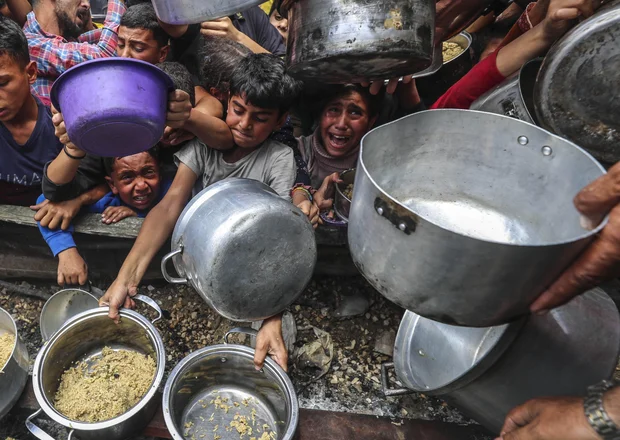
Children eagerly seek for food as charities provide hot meals to Palestinians in the Jabalia refugee camp., in the northern Gaza Strip, May 14, 2025, amid a months-long blockade of the territory by Israel.