
The President Bola Tinubu-led Nigerian government has met with Ghanaian officials in a bid to ease diplomatic tensions that rose following the protest held by Ghanaians on Saturday at the popular Obra Spot in Accra.
The protesters had demanded the immediate expulsion of Nigerians from their country over alleged involvement in crime and social vices.
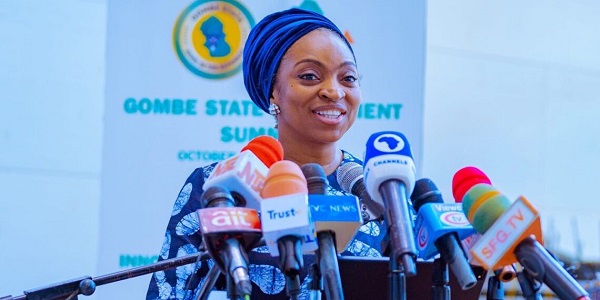
Nigeria’s Minister of State for Foreign Affairs, Ambassador Bianca Odumegwu Ojukwu, led a delegation to Accra as a special envoy of President Tinubu.
During a joint press conference on Wednesday with Ghana’s Foreign Affairs Minister, Samuel Ablakwa, Ojukwu urged calm and stressed the importance of maintaining peaceful ties between the two West African nations.
This was contained in a statement issued on Thursday by the minister’s Special Assistant on Communication and New Media, Magnus Eze.
“We are here in the Republic of Ghana on a fact-finding mission as special envoy of President Bola Tinubu as a result of recent disturbances that have made the rounds in Nigeria,” Ojukwu said.
“We are pleased to note that things are rather calm here. Since we arrived, I haven’t seen people burning tyres in the streets or carrying placards everywhere calling for Nigerians to be deported.”
The minister noted that the Ghanaian government had acted swiftly to address the situation, and that much of the panic had been fuelled by misleading viral videos.
She said her delegation had engaged with government officials, community leaders, and other stakeholders to de-escalate tensions.
Odumegwu-Ojukwu called for the institutionalisation of the Nigeria-Ghana Joint Commission to strengthen bilateral ties and foster citizen-to-citizen understanding.
Ghanaian Foreign Minister, Samuel Ablakwa, also called for calm, saying his government remained committed to protecting all residents, regardless of nationality.
“The Ghanaian government will ensure that everyone in the country, citizens and non-citizens, is protected,” he said.
However, Ablakwa urged all residents to remain law-abiding and avoid divisive behaviour.
Addressing the viral videos, Ablakwa clarified, “They are not a true reflection of the situation.”
He disclosed that he had met with the Nigerian accused of trying to establish a “kingdom” in Ghana and confirmed there was no territorial agenda behind his actions.
Ablakwa referenced historic episodes of tension, including Ghana’s 1969 Aliens Repatriation Order and Nigeria’s 1983 “Ghana Must Go” mass expulsion, urging both nations to avoid repeating past mistakes.
“Regardless of our shared history, if these things are not managed well, it will take us back to certain dark occurrences in our history,” he warned.
Recall that the protesters, who gathered in large numbers, displayed placards with messages such as “Nigerians Must Go,” “End Kidnapping,” “End Prostitution,” “End Armed Robbery,” “End Fraud,” and “End Ritual Murders.”
They accused some Nigerians of fueling insecurity and moral decay in Ghana, with some of the placards reading, “Who protects the right and freedom of Ghanaians?”, “Nigerians are kidnapping and using people for rituals,” and “Our kids are getting missing because of Igbos.”
In a viral video obtained by SaharaReporters, several protesters are seen draped in the Ghanaian national flag while others donned red clothing — a traditional symbol of resistance.
One female protester, dressed in red and holding a placard, declared, “Nigerians must go because you cannot be in someone’s country and be doing anyhow.”
Another placard read: “Our Health At Stake Due to Mass Prostitution,” explaining growing public frustration over perceived health and safety risks allegedly linked to activities of some Nigerian nationals in the country.
The protest comes amid rising tensions between Ghanaian citizens and segments of the Nigerian community, following repeated incidents of criminal activity blamed on foreign nationals.
Another protester, riding on a motorcycle, explained how the presence of Nigerians in Ghana is fueling insecurity in the country.
He said a time would come when even they and their children wouldn’t be able to go out to buy something and return home safely.
He pointed to the incident involving an official of the Ghana High Commission, who recently died in Abuja, Nigeria, after a robbery incident.
SaharaReporters reported on July 8 that protests and intense public debate erupted in parts of Ghana following the installation of a traditional Igbo leader, Eze Chukwudi Ihenetu, as the “Eze Ndi Igbo Ghana” (King of the Igbo People in Ghana).
The development triggered a complex discourse around issues of sovereignty, cultural identity, and the limits of foreign community leadership in the country.
Youth organisations in Accra and the Eastern Region led the uproar, which escalated further after photos of Eze Ihenetu’s opulent palace in Accra — featuring regal emblems and elaborate architecture — circulated widely online.
Following the controversy, the Southeast Council of Traditional Rulers recently abolished the use of the title “Eze Ndigbo” by Igbo leaders residing outside Igbo land.